Helix Journal · The Rooms · No. 14
 Danilo Ralić “The Plug”
What Is High-Level Networking, and Why Don't Events Work?
High-level networking is a capped table of vetted operators who keep returning, so repetition compounds strangers into allies, and events don't work because one-off mixers only stack names that decay toward zero within months. The table you return to outproduces the floor you rotate through. Mixers manufacture contacts, and contacts decay. A real room manufactures allies, and allies accrue.
The three filters below name what makes a room real, the event math shows why it pays, and the admission sequence shows how the doors actually open.

Why do networking events produce contacts, not allies?
Networking events produce contacts, not allies, because three minutes per exchange cannot carry the disclosure an alliance needs, and without disclosure a conversation produces a business card, not a relationship. Run the arithmetic on the last event you paid to attend: 200 attendees, two hours, three minutes each. You met 35 people at the physical ceiling, traded details with a dozen, promised follow-ups to five. Six weeks later one thread is alive, usually about nothing. Every card you collected sits in a dozen other pockets, because twenty operators worked the same floor and collected the same people. Two strangers performed elevator pitches at each other and rotated on, so no relationship occurred and nobody owns one. The names you kept are names a hundred other badges kept too. The decay is the format working as designed, not a failure of your discipline.
Name badges accelerate the decay, because a badge turns every exchange into a transaction between job titles.
A badge announces your function before you open your mouth, and people negotiate with functions instead of disclosing to them. Picture the floor at any founder conference: a thousand capable operators, and not one of them naming a real margin, a real mistake, or a real fear to a stranger holding a lanyard and a beer. Performance is the rational play when your audience is strangers who judge you in three minutes, and performance is the opposite of disclosure. Disclosure is the raw material every alliance is built from, and what you carry home from a conference floor is not disclosure but mutual awareness, the kind that expires in weeks.
Context, the thing high-level networking actually trades on, never had a chance to form.
The deeper failure is categorical: events optimize for collection, and collection answers a different question than connection does. Why networking produces acquaintances instead of friends has its own mechanics, unpacked in the page on founder friendships.
Some argue the event is fine and the follow-up is the skill: send the email within 48 hours, book the call, convert the contact. Take that objection at its strongest, because disciplined operators do convert a handful of event contacts a year. Here is what no follow-up can restore: context. A booked call between two people with zero shared history, zero witnessed behavior, and zero mutual stakes is a cold meeting with better manners. You are strangers with a calendar invite. Compare it to a second dinner with the same twelve operators, where someone remembers the hiring problem you named in March and asks how it ended. The gap is architecture, not effort. Email cadence cannot manufacture history; only repetition can.

The math flips in exactly one situation, and an honest page names it before moving on.
Events win when your job is volume: hiring at scale, filling a webinar, finding the first 50 leads, or testing a pitch on a disposable audience. A mixer is a collection machine, and collection is sometimes the correct job. The mistake is asking a collection machine to produce allies, the same mistake that leaves an operator with 2,000 contacts and a hard case of founder loneliness.
Match the format to the job before you buy the ticket, because each one pays off in a different currency.
| Format | What you walk out with | Half-life | Best when the job is |
|---|---|---|---|
| Big conference | Awareness and a stack of cards | Weeks | Reach, lead-gen, pitch-testing |
| Curated dinner | A handful of warm names | Months | Meeting peers at your level |
| Recurring capped room | Allies who answer at midnight | Years, compounding | Depth that outlasts a quarter |
Drag the slider below and try to make events win. The curve is the argument.
Interactive · The Decay Curve
Try to make events win
Line A: contacts collected at events, decaying on a follow-up curve. Line B: one recurring room, compounding every time the table is set.
At month 24: — event contacts still warm · — relationships at the recurring table
Model: each event adds 18 exchanges that decay on a follow-up half-life; the room compounds across a trip-and-dinner calendar. Annotated outcomes are published Helix data, labeled by what the room can and cannot claim.

What separates a high-level room from a networking event?
A high-level room is separated from a networking event by three filters: who selected the people, how many seats exist, and how often the same faces return. Each one is checkable from the outside before any money moves. Start with selection, where the instrument matters more than the standard. A ticket price screens for disposable income; an application a human reads screens for substance. Hampton, the vetted founder community Sam Parr co-founded in 2022, admits roughly 8% of applicants, and the percentage matters less than the mechanism under it: a person says no. Helix (private vetted founder community, founded 2024) runs the same mechanism at smaller scale, every application read by its founder. A fee cannot do this work, because money only screens for money. A $2,000 ticket buys a room full of people who had $2,000.
Whoever can say no, and does, is the filter; everything else is price discrimination wearing a velvet rope.
Filter two is the cap, and a cap changes behavior in ways no 10,000-member network can copy. At 100 seats everyone is known by name, so reputation inside the room persists: what you do at dinner in Marbella follows you to the next table. Persistence rewires incentives. Pitching, selling, and harvesting stop, because the person you would pitch will sit across from you for years, while a conference floor resets to fresh strangers every morning. The cap also fails quietly, when small gets mistaken for selected. Eight golf friends with a logo are capped too, and a shrinking paid group is exclusive by accident. Capped and curated have to arrive together, or neither is worth paying for.
Filter three is repetition, and repetition is where members clubs quietly fail. Soho House (the members club chain Nick Jones opened in London in 1995) sells access to buildings, not to a fixed cast of people.
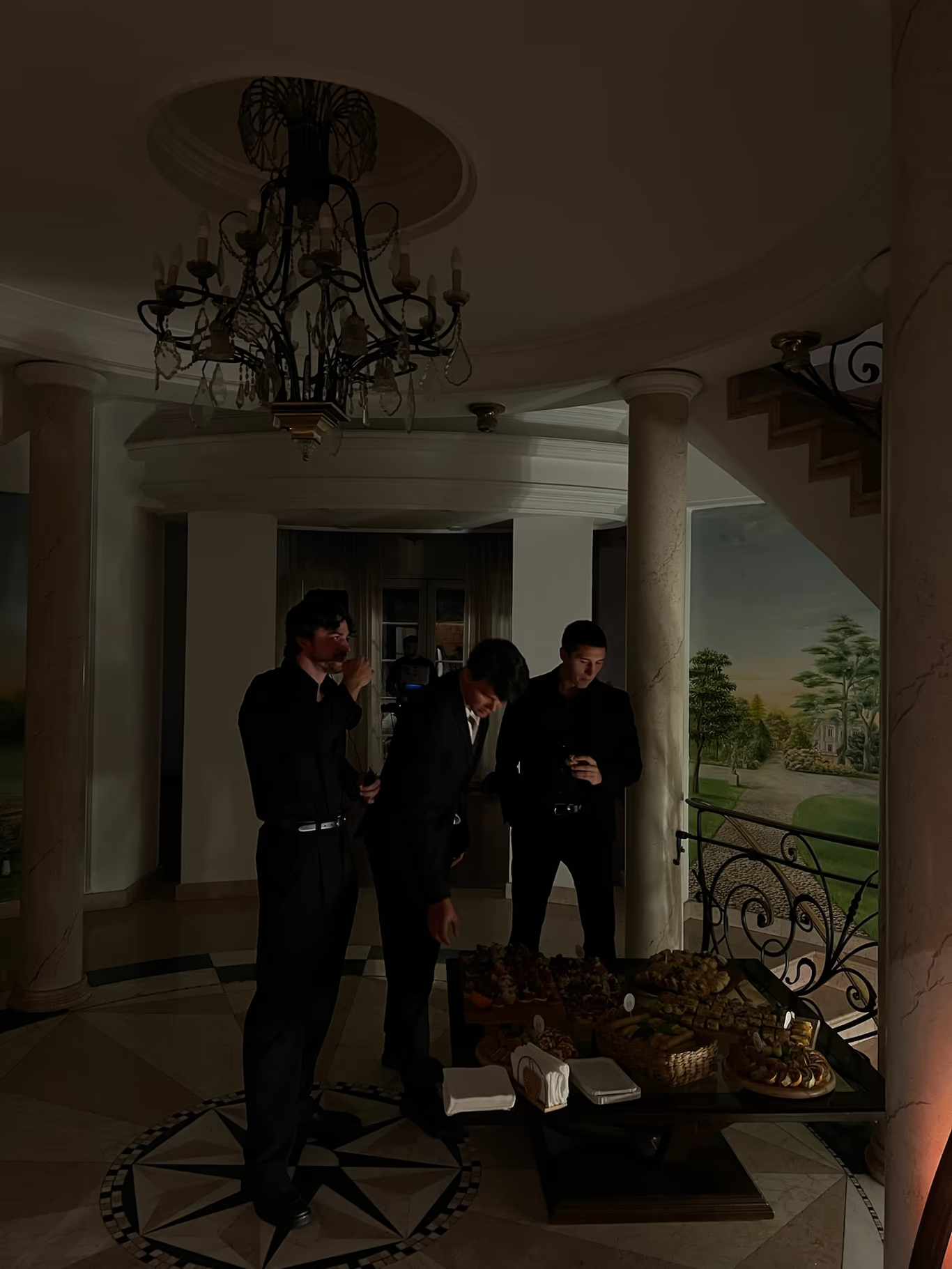
A roof is not a room. The crowd inside changes nightly, so the club reproduces the mixer problem with softer chairs and a dress code. A community that travels inverts the model: the same faces across Belgrade, Marbella, and Cape Town, until the operator you met at dinner one is the ally who answers at midnight by trip three. Trust forms across instances, not introductions, which is why repetition holds contacts a list never could. Count the instances before you count the members.
The gates stack up cleanly once you name what each one actually screens:
| Gate | What it filters | What slips through | Typical home |
|---|---|---|---|
| Ticket price | Spare cash this quarter | Anyone between jobs and curious | Conferences, paid mixers |
| Recurring fee | Tolerance for a line item | Lurkers who renew and vanish | Online networks, city clubs |
| Application a human reads | Claims someone can check | Polished writing over thin operations | Vetted communities |
| Referral plus review | Behavior a member will vouch for | Very little, and slowly | Capped rooms |
Money clarifies the comparison faster than any brochure. A $2,500-a-year club membership buys square footage: meeting rooms, a bar with standards, proximity to strangers in your income bracket. A vetted seat buys high-level networking as this page defines it: a person who said no to others on your behalf, a cap that keeps reputation persistent, a calendar that keeps the same people returning. Neither is a scam; they buy different assets. Pick the club when what you lack is a venue. Choose the vetted room when what you lack is people who know your situation and will still know it next quarter. Free rooms win early, when you need reach over depth and any serious filter would exclude you anyway. Structured peer groups sit between the two, trading venue for cadence at a revenue threshold.

From the founder's journal
Networking doesn't send you an invoice. The biggest returns in life come from bets you can't quantify until after you've made them. If you need certainty before you move, you'll never move.
Danilo Ralić — “The Plug,” Helix founderHow do invite-only rooms actually admit people?
Invite-only rooms admit people through one sequence: a referral, a written application, and one human's judgment, which together open nearly every door in high-level networking. Labels vary across the category, but the spine repeats because nothing else scales trust. Software can score volume; only a person can weigh whether a specific operator improves a specific table. The rooms worth joining spend that human attention before you arrive, not after.
Take the one sequence published end to end, because most rooms keep theirs vague. Admission to Helix starts with a Typeform titled Request a seat, and the form takes four minutes. Danilo Ralić, the founder, reads every application himself, against a roster capped near 100 seats with 11 members named in public, from Tim Petzold (Poddie) to Liam Clancy (PlusHeat UK). The read weighs three things: what you operate, what can be verified, and what you would add to a table that already works. A conversation follows when the application holds, a seat when the answer is yes. No software touches any stage, so the timeline runs in days and weeks, not seconds. What you wait on is the judgment itself, documented stage by stage in how vetting works.
Patience is part of the application, because urgency is what extraction sounds like from the outside.
Getting the nod is preparation you can start this week. Reviewers check what can be confirmed: a company with your name on it, numbers that survive a search, customers who exist outside testimonials. They read for contribution over extraction, so an application should sound like someone bringing dinner, not someone arriving hungry, and a referral lands hardest when a member vouches for your behavior rather than your exit. Widening where members can meet you helps too, and the guide on how to meet other founders maps those venues.
Before you open the form, get these five in order:
- Proof of a company a stranger can find: your name attached to something real, not a stealth-mode slide.
- Numbers that survive a search: revenue, headcount, or traction a reviewer can cross-check without taking your word.
- One member who will vouch for how you behave: the person who watched you under pressure, not the one who saw your exit press release.
- Specifics on what you would add: name the table you would improve, not the favors you want pulled.
- Patience for a human timeline: the read runs in days and weeks, and chasing it reads as the extraction the gate exists to catch.
The approach breaks when you treat the review like a sales funnel. Pitching the reviewer signals extraction, the precise trait every gate in this category exists to keep out, so write like a future peer or wait until you can.
One introduction can move a decade, and the claim survives contact with specifics. A sports-education founder grew from $200k to $2M in annual revenue inside twelve months, after introductions made at this table; that outcome the room claims, while the roster's $30M-a-year e-commerce operator built his business before his seat, so the room does not. Rooms that label outcomes that carefully are proving the filter works, the last thing to verify in high-level networking and the easiest to fake everywhere else.