Helix Journal · The Rooms · No. 12
 Danilo Ralić “The Plug”
What Are CEO Peer Groups, and Who Are They For?
A CEO peer group is six to twelve non-competing chief executives meeting monthly under absolute confidentiality to pressure-test the decisions nobody above them can check, and it is for the founder or chief executive who has outgrown every adviser inside their own company. It is not coaching, not a course, not therapy, and not a circle for selling to each other. Strip any of those conditions and what remains is a networking event with better chairs. The format suits operators whose decisions now move six figures and whose hardest calls reach nobody on the payroll, from the sole founder to the CEO of a scaled company, priced anywhere from $49 a month to $25,000 a year.
What actually happens inside a CEO peer group?
Inside a CEO peer group, each member brings one live decision and the table cross-examines the thinking before anyone recommends anything: a typical seat opens with the real numbers, moves through clarifying questions, and closes with commitments read into a shared record. The presenting member speaks last in the discussion, not first. Questions outrank opinions for the first half of every seat, because the room's job is finding the problem under the presented one.
Vistage (chair-led peer advisory organization, est. 1957) runs the best-known version: 12 to 16 executives, one full day a month, steered by a paid chair who polices airtime and follows up between sessions. EO (Entrepreneurs' Organization, est. 1987) runs the member-led counterpart, a Forum of seven to ten owners meeting monthly for half a day with a trained member moderating. EO's Gestalt protocol bans advice outright; members share only what they did when they faced the same call. The ban sounds precious and works. Advice costs the giver nothing, so rooms drown in it, whereas lived experience is rationed by what each member survived. That rationing is what a peer advisory board sells: three base rates from operators who carried your risk, not eleven guesses from people who never have.
Other operators' scar tissue, rationed out monthly, is what the seat buys.
The three best-known organizations sort cleanly by who polices the room and how strictly they ration advice. Read the table as one axis, the firmer the hand on airtime, the harder the rule on giving advice.
| Organization | Who leads | Typical size | The advice rule |
|---|---|---|---|
| Vistage (est. 1957) | Paid chair at the head | 12 to 16 executives | Chair steers airtime and follows up between sessions |
| EO Forum (est. 1987) | Trained member moderates | 7 to 10 owners | Gestalt protocol bans advice; share lived experience only |
| Helix (est. 2024) | No chair, members own it | ~100 vetted seats, capped | One standing rule, what is said at the table stays at the table |
The returns arrive in order: decision speed first, since a call pressure-tested before execution ships with less of the second-guessing that compounds into decision fatigue. Accountability comes second, because employees cannot hold a chief executive to a commitment, and that absence is half of why founders get lonely; pattern access comes third, and it compounds, because someone at a well-built table has already survived your current problem.
Four behaviors kill a CEO peer group faster than any pricing mistake:
- Selling. The first pitch aimed at the table converts every member from peer to prospect. Candor exits with the trust.
- Recruiting. Poaching a member's operations lead is acting on table information. The confidentiality rule exists to prevent exactly that move.
- Fundraising. A member running an open round hears every update as an objection. The seat stops examining and starts persuading.
- Spectating. Whoever absorbs without disclosing converts the room into free consulting. The others notice within two sessions.
The quieter failure is rotation. This format breaks when one member's crisis owns the deep-dive seat for three consecutive sessions, because the others stop preparing real material and the meeting decays into a support call for one business.

How do CEO peer groups work: size, cadence, and rules?
CEO peer groups work by holding three constraints fixed: six to twelve members, a set monthly cadence, and written confidentiality with zero exceptions. That size band is where every durable format lands, and the reason is airtime arithmetic. A three-hour session split across ten businesses budgets eighteen minutes of scrutiny apiece; stretch the same clock across twenty seats and scrutiny turns into status reporting.
Below six seats, the pattern library thins out: your pricing crisis meets only four other operating histories, and the odds one of them matches drop sharply. Above twelve, members spectate, which is why the biggest chaired groups pay a professional to ration minutes. How a vendor scales tells you what it optimizes for. Vistage advertises more than 45,000 members and EO sorts its thousands into city chapters, so both grow by adding rooms. Helix (private vetted founder community, est. 2024) caps the entire community at about 100 seats instead of scaling chapters, so the same names recur at every table it sets. Incumbents multiply rooms; a capped community deepens one.
Size is an airtime budget long before it becomes a culture problem.
Cadence sets the depth ceiling, and the market gives two honest answers. The standard is one half-day or full-day meeting per month, costing a chief executive ten to fifteen working days a year once preparation and travel are counted; chaired programs add a private one-to-one with the facilitator. Skip two months and the room forgets the texture of your business, so every seat restarts at the summary instead of the substance. Immersive formats invert the trade: fewer meetings, but days of them, the same logic that makes founder retreats outperform a year of video calls for trust. A monthly seat reaches the problem you prepared to present. The third day of a trip reaches the one you had no plan to mention.
Confidentiality is the load-bearing rule, and it only works written down and absolute. What is said at the table stays at the table translates to three prohibitions: nothing gets retold, nothing gets acted on, nothing gets confirmed. Most founder dinners run on a looser norm, the "off the record" handshake that still lets you quietly act on a competitor's churn number once you drop the name. A peer table permits neither the use nor the retelling, and it grants no exception for spouses, cofounders, or business partners.
Pin the working version to the first page of the group's charter:
- Never retell. Not to a spouse, not to a cofounder. Not to your own leadership team.
- Never act. No hire, no trade, no deal built from a member's disclosure. The one exception is that member handing it to you.
- Never confirm. The only correct response on another member's business is silence. You cannot speak to it, so you do not.
- Always flag conflicts. A member who realizes mid-seat that a topic touches their own interests says so at once. The seat continues only when the presenter is comfortable.
Groups without an explicit version fail quietly rather than loudly. Nobody announces the breach; members simply bring smaller problems each quarter until the meeting holds nothing worth protecting.
Watch what the rule changes once an investor holds a seat. Benjamin Schwarzenbach (partner at Swiss Ark Partners, a Swiss investment firm) sits at a vetted founder table where the no-acting clause binds him exactly as it binds every operator present, and that symmetry is the only arrangement under which founders keep discussing real numbers in front of capital. Strip the clause and his presence would mute the room; keep it and the table gains a member who prices risk for a living.
Direct competitors never share a group in any serious format, because honest margins do not surface in front of a rival. The harder case arrives mid-membership, when one member pivots into a market a current peer already serves. Well-run groups re-seat one of the two inside a quarter, and a group that cannot name one enforcement has a rule made of air.

From the founder's journal
He used to say there's nothing tangible in networking, that he just focuses on his work — until a week in the room flipped it completely. From “networking doesn't matter” to realizing it's the cheat code.
Danilo Ralić — “The Plug,” Helix founderWhich peer group format is right for you?
The right peer group format matches enforcement to stakes: a free roundtable for tactical questions, a chaired forum for six-figure decisions, and a standing community when belonging rather than agenda is the gap. Beneath that map sit two variables, who enforces the room and how much calendar you will genuinely give it; everything else on a sales page is upholstery.
Chair-led forums buy enforcement. A professional facilitator keeps the agenda honest through weak months, which is most of what the fee buys; the bill arrives later as chair dependence, since groups built around one strong chair tend to dissolve within a year of that chair retiring. Member-led rooms run cheaper and feel owned, and they decay through attendance instead: the first skipped month sets a precedent, the third makes it culture. Executive roundtables sit at the casual end, breakfast circuits and invitation lists that cost little and bind nobody. Online masterminds package the same hot-seat skeleton over video at every price on earth, and the mastermind cost math gets its own breakdown. The fourth format skips the meeting model and builds a standing community that travels.
The format is the easy part; the room either holds candor or it does not.
Some argue the entire category is pooled ignorance: a circle of people who lack the answer, averaging their guesses. The critique describes badly run rooms and misses the design of good ones. A founder who brings a pricing question to a loose room leaves with eleven opinions and no more conviction than they walked in with. The same founder at a disciplined table leaves with three operators reporting what a price change actually did to their churn and their close rate, which is data, not a vote. EO built its Gestalt rule for exactly this failure, since reporting what you did and what it cost, never what someone should do, turns a session from opinion-averaging into evidence collection. A chaired group adds a professional whose single job is stopping the loudest voice from anchoring the room. The format never promises that the answer sits at the table; it promises the decision leaves sharper than it arrived.
Interactive · Anatomy of the Table
Four rooms, one decision
Tap a table to read its spec: size, cadence, confidentiality, real cost, and the way it usually fails.
Chair-led forum
- Group size
- 12 to 16 executives, one paid chair at the head.
- Cadence
- One full day a month, plus a private one-to-one with the chair.
- Confidentiality
- Written charter, enforced by the chair as part of the job.
- Real cost
- $12,000 to $17,000 a year at the Vistage tier.
- Fails when
- The chair leaves. Groups built on one strong facilitator dissolve within a year of that retirement.
Executive roundtable
- Group size
- 8 to 20, loosely held; the invitation list drifts.
- Cadence
- Monthly breakfasts or quarterly dinners, lightly scheduled.
- Confidentiality
- Informal and rarely written down, which means optional.
- Real cost
- Free to low dues; it binds exactly as tightly as it costs.
- Fails when
- Attendance decays. The first skipped month sets a precedent; the third makes it culture.
Online mastermind
- Group size
- 6 to 12 per group, one rotating hot seat per session.
- Cadence
- Weekly or monthly video sessions, 60 to 180 minutes.
- Confidentiality
- Stated at onboarding, unevenly enforced after it.
- Real cost
- $49/mo squads to $25k+/yr rooms; structured offline organizations sit between those poles, dues varying by chapter.
- Fails when
- Guru dynamics set in: a famous name at the center turns peers into an audience.
Travel-first community
- Group size
- ~100 vetted seats in the whole community; tables form anew on every trip.
- Cadence
- Tables set in a different city each time: seven trips logged since 2024, four more destinations vlogged.
- Confidentiality
- Vetted seats and one standing rule: what is said at the table stays at the table.
- Real cost
- No public price. Every application is read personally first; the form takes four minutes.
- Fails when
- Vetting drifts. A cap that quietly rises converts depth back into scale, which is what the hard cap exists to prevent.
Price the whole market once and keep the map. Facilitated online squads start at $49 a month, the $588-a-year floor of the category. Vistage runs $12,000 to $17,000 a year for the chaired group plus the monthly one-to-one. Top masterminds open at $25,000 and climb. Executive roundtables cost nothing beyond the breakfasts, and they bind exactly as tightly as they cost. Read the spread as one variable: each tier up buys more structure holding the room together in the months motivation dips. No tier sells belonging, because a meeting that adjourns at five returns you to deciding alone at six.
Dues buy the enforcement; candor has never once appeared on an invoice.
The rubric is short. Pick the roundtable when your questions are tactical and your calendar is hostile, because a free breakfast you attend beats a chaired forum you skip. Choose a chaired forum once your decisions move six figures, the point where paid enforcement becomes the better choice and a missed month stops being cheap. A member-led forum is the right fit for operators disciplined enough to police their own attendance and rotation. The honest test is which failure you would rather risk: paying for structure you might outgrow, or owning a room you might let lapse. When the gap in your week is bigger than a meeting, when the goal is to meet other founders who keep existing between sessions, you have stopped shopping for a format and started shopping for a room.
Before you take a seat anywhere, put five questions to whoever runs it:
- Who screens new members, and how? A roster that lets anyone with a checkbook in is the first sign that vetting has stopped doing its job.
- When was a seat last moved over a competitive conflict? A group that cannot name one enforcement has a confidentiality rule made of air.
- Is the confidentiality standard written down? Verbal rules fail quietly; ask to read the charter before the first meeting, not after.
- What happens the month the chair or strongest member leaves? Chair dependence is the failure that dissolves groups within a year of a retirement.
- How is airtime rationed across the room? Without a defended clock, the update round eats the session and scrutiny turns into status reporting.
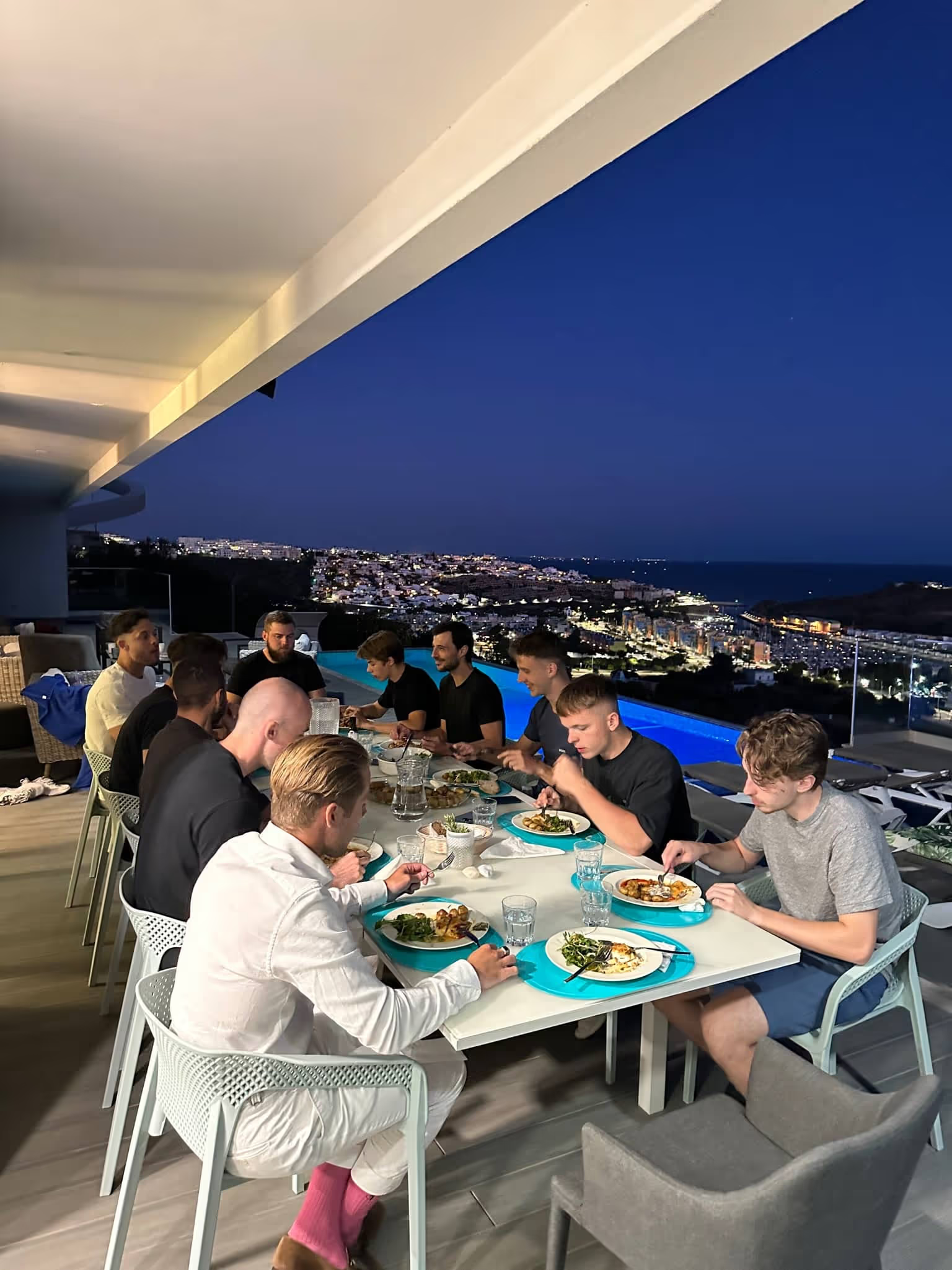
Helix exists for that last case. The community holds a hard cap near 100 seats, founder Danilo Ralić reads every application himself, and the table convenes in a different city each time: seven trips logged since 2024, Belgrade to Albufeira, four more destinations vlogged across 12 public films. The ledger stays honest about causation. A sports-education founder grew from $200k to $2M in annual revenue within twelve months of introductions made at the table, an outcome the room can claim outright. The $30M-a-year e-commerce operator and the EdTech founder past a $10M valuation are what the vetting selects, not what the table caused. One set shows what the room produces; the other shows who it lets in.
Helix runs the fourth format. No chairs, no badges, no chapters: one vetted community capped near 100 founders, every application read personally, and tables set in a different city each time. If peers are the missing structure, request yours.