Helix Journal · The Weight · No. 7
 Danilo Ralić “The Plug”
What Does a Support System for Entrepreneurs Look Like?
A support system for entrepreneurs looks like four occupied seats: a mentor for hindsight, a coach for pressure, a therapist for the emotional load, and calibrated peers for proof. Most founders fill three of the four: they find the mentor, hire the coach, book the therapist. The seat that stays empty is almost always the same one, and it is the only seat that sees both the business and the person.
Two axes sort every helper you will ever hire or call: directive versus reflective, business load versus personal load. This page maps the four roles onto that grid, hands you a builder that finds your own dark quadrant, and explains why the empty corner is so rarely an accident.

What are the four kinds of founder support, and what can each one carry?
The four kinds of founder support are mentors lending hindsight, coaches pushing output, therapists holding the private weight, and peers verifying your numbers, and each one carries exactly one load. Outside its lane, every role stalls: a mentor outside hindsight, a coach outside pressure, a therapist outside the personal weight, a peer outside your live numbers.
A mentor trades in borrowed hindsight. They ran your road a decade earlier, and their value is compression: fewer experiments, faster pattern recognition, an introduction at the exact moment it matters. The doors they open often outweigh the advice, because an endorsement spends their reputation on your behalf. General hindsight is cheap, though; plenty of founders get it free from an operator one stage ahead who likes them, which tells you what raw advice is worth. What a mentor cannot give you is cadence, because the relationship runs on occasional high-leverage calls and chasing more frequency kills the goodwill that powers it. Hindsight also expires quietly. A founder who scaled a retail brand in 2009 will misread your 2026 acquisition economics with total confidence, and the seat breaks hardest when the market shifts under their pattern library before either of you notices. Take the playbook, then check it against an operator who is in the market right now.
A coach works the opposite direction in time. Where the mentor mines a finished past, the coach builds your next quarter on a paid weekly or biweekly rhythm, the lightest of the accountability structures money can buy. Bill Campbell (the Silicon Valley coach who advised Steve Jobs and Eric Schmidt) made the role famous, and the detail worth stealing is who he pushed: operators who already had every answer available to them. Pressure was the product, not information. That marks the ceiling too. A coach can ask whether your 8% net margin worries you, but cannot tell you whether 8% is normal, because they have never run your model and their other clients sell entirely different things. Buy the push when push is missing, and source proof somewhere else.
A therapist carries what neither of those seats is built to hold: identity fused to revenue, sleep that tracks your cash position, a marriage absorbing the company's moods. A licensed clinician is also the only seat bound by confidentiality law rather than goodwill, which changes what you can say in it. The limit runs the other way, because your therapist cannot read a P&L, and when the load is operational exhaustion rather than clinical distress, the repair work sits closer to founder burnout than to a diagnosis. Calibrated peers close the square. A peer running a comparable company this year is the only role that sees your numbers and your face at the same time, and answers the question every other seat must dodge: is this normal?

Four roles, two axes, one budget. Hold every helper you currently pay or call against this map before you add another:
| Role | Quadrant | What it carries | What it cannot carry |
|---|---|---|---|
| Mentor | Directive · business | Borrowed hindsight, opened doors | A weekly rhythm; current-market calibration |
| Coach | Directive · personal | Forward pressure, blind-spot checks | Proof that your numbers are normal |
| Therapist | Reflective · personal | The emotional weight, under confidentiality law | P&L context for business calls |
| Calibrated peers | Reflective · business | Numbers-and-person calibration | Nothing structural; only access limits it |
Some argue a great coach makes the other seats redundant. Half of that holds. A coaching credential certifies process: the coach is trained to ask strong questions, not to know your sector's economics. So test the claim instead of debating it. Ask a coach candidate what a healthy blended acquisition cost looks like in your niche this quarter. Then put the same question to two operators who buy the same traffic you do, and watch which answer is usable on Monday. One comes back as a live number attached to a real company; one comes back as a question reflected at you. Both are useful, and only one is calibration.
How do you map your own founder support system?
You map your own founder support system by drawing two axes and seating every helper you actually call against them; the empty quadrant shows itself inside a minute. Directive helpers sit on one side, reflective ones opposite, with business load above and personal load below, so each of the four real people lands in exactly one corner and any corner left nameless is your gap.
The builder below runs that audit for you. Tap the seats you already have filled, real names only, and the table draws your personal map with the missing quadrant left dark:
Interactive · Support Map
Four seats, two axes
Tap the supports you currently have. Each seat shows what it carries and what it cannot; the quadrant you leave dark is your gap.
Most sessions end with the same quadrant dark: calibrated peers.
Member poll in progress — live data ships with it
What the ~100 members actually pay for or use, and which seat they filled last before joining, publishes here when the four-checkbox poll closes.
One informal structure ties the four seats together: the personal board of advisors. Treat it as a real board with fake formality. Name five or six people across the quadrants, tell each one they hold a seat, and bring each the class of problem their quadrant owns. It costs nothing, and what it fixes is routing, the most common error founders make with help they already have. A pricing decision goes to peers, not to your therapist; a collapsing week goes to your therapist, not to a hot seat. Choose the seat by the load you carry, not by who answers fastest.
Assemble that board with a short checklist before you go shopping for more help:

- Name a real person per quadrant. A seat with no name attached is a gap you have not admitted yet. Write the name down before you go looking for a fifth helper.
- Route by load, not by speed. Send the pricing question to peers and the collapsing week to your therapist, even when someone else replies first.
- Keep one person to one seat. An investor in the mentor chair and a spouse in the therapist chair both distort the seat they fill. Separate them even when one person could plausibly cover two.
- Audit the board every quarter. The seat that quietly emptied is usually the one carrying the most this year.
- Vet peers for adjacency without overlap, close enough to read your numbers and far enough to gain nothing from your weak quarter.
The map breaks when one person holds two seats. An investor who mentors you cannot hear what a neutral mentor can, because your downside is their portfolio, and a spouse drafted into the therapist seat eventually files for a role change. Jerry Colonna (founder of the executive-coaching firm Reboot) built a practice on the coach-therapist border and still describes coaching as a complement to therapy rather than a replacement, which is the correct read: separate the seats even when one person could plausibly cover two. Helix (a private vetted founder community, founded 2024) is running the four-checkbox version of this audit across its roughly 100 seats: which of the four supports do members currently pay for or use, and which seat they filled last before joining. That distribution, the first published from inside a working support system for entrepreneurs at this level, appears in the builder above when the poll closes. The overlay ships in a labelled placeholder state until then, because no invented percentage belongs on this page.
Most maps drawn in this builder go dark in the same corner, and it is not the therapist's.

From the founder's journal
Every day, someone in the room can impact my life in ways I couldn't even dream of before. Money stops feeling like numbers on a screen, and you finally feel like the main character in your own story.
Danilo Ralić — “The Plug,” Helix founderWhy do founders fill the peer seat last?
Founders fill the peer seat last because nobody sells it: coaches arrive through ads, therapists through directories, but a calibrated peer must be found, vetted, and earned by hand. No vendor pushes that work up your list, so nothing ever prompts the purchase and the seat that needs the most effort gets it last.
The payoff for doing it anyway is the one capability money cannot deliver: disconfirming evidence from people at your scale. The voice insisting your results are luck, the one founder imposter syndrome runs on, survives on missing comparisons. Six operators confirming your churn is normal kills it faster than a year of affirmations. Decisions reprice the same way: a question you have circled for three weeks resolves in one dinner, once two people who made that call last year tell you what it actually cost.
Formats for this seat run a spectrum of structure. CEO peer groups assign you a fixed cell with a chair and a monthly agenda, mastermind groups rent you a rotating hot seat on a schedule, and a standing community keeps the same vetted faces beside you, with travel doing the trust-building an agenda cannot. The three differ less on price than on what they actually structure, cadence, vetting, and whether the same faces stay across sessions.
| Format | Cadence | Vetting | Best for |
|---|---|---|---|
| CEO peer group | Monthly meeting, fixed cell | Chaired, screened on entry | One defined problem to process on an agenda |
| Mastermind group | Scheduled rotating hot seat | Varies by organizer | A founder who wants a recurring slot, not the same faces |
| Standing community | Continuous, in-person trips | Founder reads every application | Problems that change faster than an agenda can |
Pick the format by the shape of your problems: sessions suit a founder with one defined problem to process, while the standing table is the better choice when your problems change faster than an agenda can.
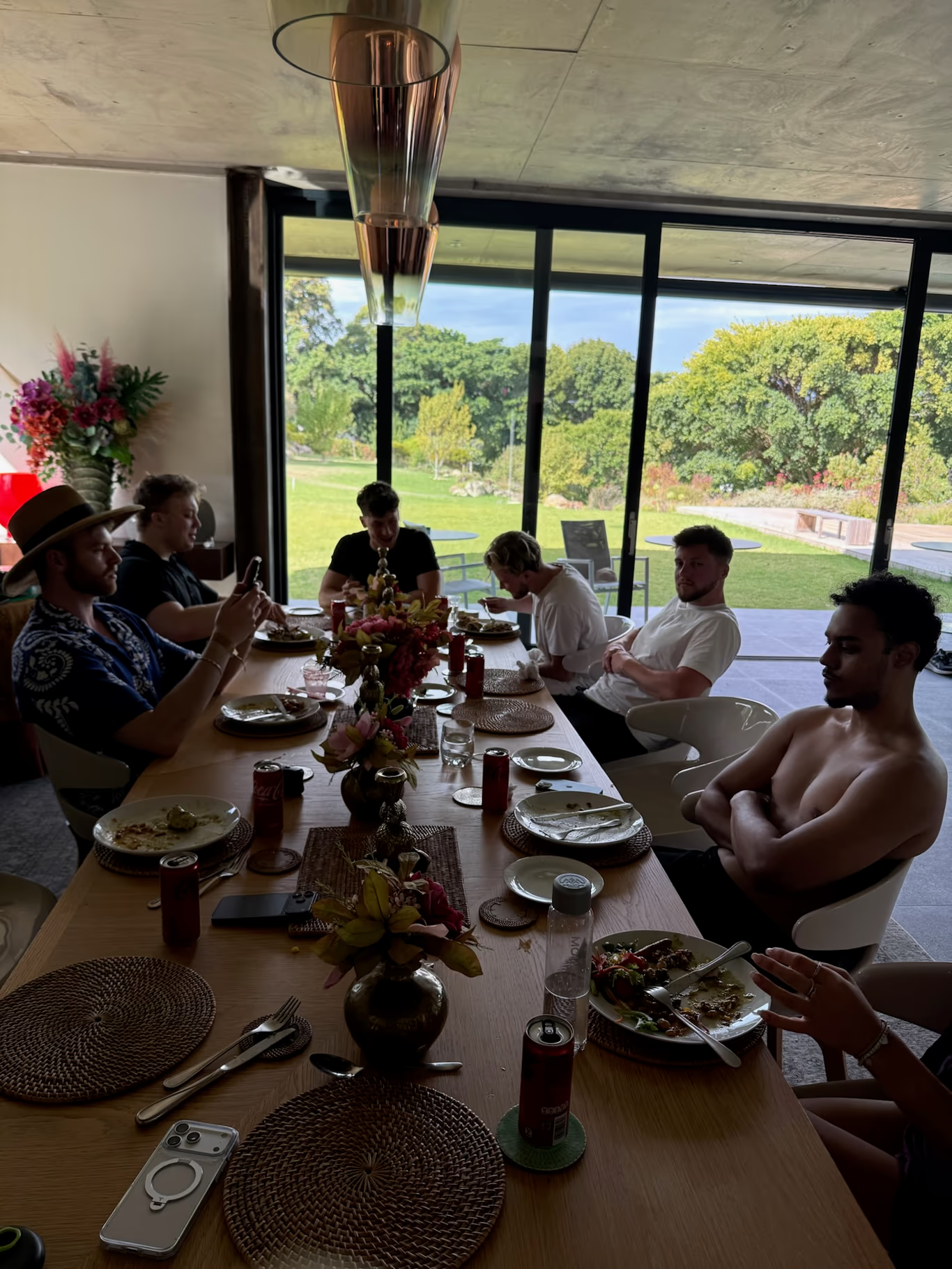
Helix is the version of that third format this page can open completely. Founder Danilo Ralić reads every application personally, and since 2024 the table has been set across 60+ trips on 4 continents, Belgrade to Cape Town to Koh Samui. The roster is public down to names and companies, so you can check every company on the list before you apply, named operators like Rolands Plotnieks (founder of NUDL) on a public roster of 70+ members. One outcome is attributable in the strict sense: a sports-education founder grew from $200k to $2M in annual revenue inside twelve months, after introductions made at the table. The rest of the roster's numbers, an e-commerce operator past $30M a year among them, predate the room and belong to the members who built them. Judge any peer seat by what its table can verify, and this one publishes its receipts.
A cofounder does not fill this seat, even free. They share your dashboard, your biases, and your blind spots, so their sample size is the same single company as yours, they can no more tell you whether the trouble is your market or your model than you can, and a cofounder is in the boat with you rather than rowing a different one on the same water. One configuration poisons the seat the same way from the outside: peers drawn from your competitor set or your customer base. Candor reverses into positioning the moment the person across the table profits from your weak quarter. So vet for adjacency without overlap, operators close enough to read your numbers and far enough to gain nothing from them.
The full support system for entrepreneurs ends up as a routing table: hindsight from a mentor, pressure from a coach, weight to a therapist, calibration from peers. Three of those seats accept a credit card this week. The fourth has to accept you, which is why the search starts with the founder community guide and ends at a private founder community whose roster, cap, and calendar you can verify before deciding it is the right fit.