Helix Journal · The Weight · No. 13
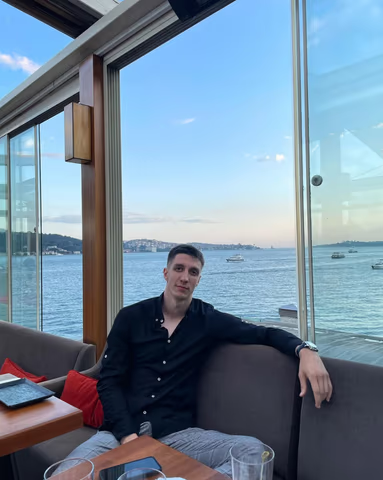
 Danilo Ralić “The Plug”
What Is Founder Burnout, and How Do You Prevent It?
Founder burnout is deep exhaustion hidden behind a functioning company, and you prevent it by building three legs of support in calm weather: a therapist, a coach, and founder peers. The signals are specific: decision fatigue a full night's sleep no longer fixes, self-worth wired to the revenue line, and a guilt reflex every time you try to stop. Each leg carries a job the others cannot, and scheduled belonging turns recovery from a promise into a calendar before the season that needs it arrives.

What does founder burnout look like, and how common is it?
Day to day, founder burnout looks like decision fatigue that outlasts a full night's sleep, rest that triggers guilt, and identity fused to the revenue line, and it is common because the seat itself runs on conditions that wear most operators down, not because founders are fragile.
The founder version hides inside high performance. Meetings still run, payroll still clears, the board update ships on time. Underneath, decisions that took minutes now take days, and a small one weighs the same as a large one. A pricing change you would have shipped in an afternoon sits open for three weeks. Rest stops repairing anything: a weekend off produces guilt instead of energy, and a soft month reads as a verdict on you rather than on the business. Friends without payroll cannot see it, employees are the last people you would tell, and the isolation underneath runs on its own mechanics, mapped in founder loneliness. Nobody catches it early because the whole condition is engineered to look like diligence.
It is not rare, and it is not a defect in you. Founders carry this strain at rates salaried operators do not, for one structural reason: the job is the variable that changed. A salaried operator hands the worst pressure up the chain at 6pm and goes home; a founder is the chain, so the pressure has nowhere else to land. The same person who would have shrugged off a hard quarter as an employee now reads it as a verdict on themselves, because the company and the self have quietly fused. That moves the real question from what is wrong with you to what is wrong with the conditions you run under — which is the only version of the question you can actually change.
Read that as context, not destiny: common because the job is built this way, not because you are weak.
The signals are concrete, not vague, and most surface well before the crash does. They tend to show up in roughly this order.

- Decision fatigue that outlasts sleep. Choices that took minutes now take days, and a small one weighs the same as a large one.
- Rest that produces guilt instead of energy. A weekend off reads as time stolen from the company rather than time that repaired you.
- Self-worth tracking the revenue line. A soft month lands as a verdict on you, which is identity fusion doing its quiet work.
- Privacy by default. Friends without payroll cannot see it, employees are the last people you would tell, and investors get the edited version.
- Numbness toward work you used to love. Functioning continues while the interest behind it quietly drains out.
Founders postpone help for three reasons, and status sits at the center of all three.
Who complains at this revenue, with this team, with these investors watching? Admitting strain feels like handing doubt to people whose confidence you cannot afford to lose, so the strain gets managed privately, which means not at all. Success sharpens the trap rather than springing it, and the doubt trailing a public win is a close cousin of imposter syndrome. The third reason is the quietest: nobody around you can notice early, because everyone who sees you daily reports to you. Investors get the polished version, the team gets the confident one, the unedited version goes nowhere.
Postponement, not severity, is what turns a recoverable season into a clinical one.
Self-recognition also has a hard limit, and this section breaks down at exactly that point: where founder burnout meets clinical depression, no article can tell you the difference. A professional can, usually inside one conversation. That single conversation is the cheapest diagnostic you will ever buy.

Who belongs in your burnout support system?
Your burnout support system needs three people, each carrying a different load: a therapist for the patterns underneath, a coach for performance, and founder peers for the present tense.
Each leg has a precise job, and the jobs do not overlap. A therapist works on the machinery underneath: the history that wired self-worth to revenue, the patterns that make rest feel like theft. A coach works on the operator: decision quality, delegation, whether next quarter repeats this one. Peers carry what neither can, the present-tense reality of the seat, held by people whose companies could also miss payroll next spring. A therapist has never sweated your cash position, a coach is paid to push rather than sit beside you, and peers simply recognize the week you are having because they had it in March. Hand a therapist a board crisis and you waste the hour; hand peers a clinical relapse and you endanger someone. The full architecture, including where mentors fit, is mapped in your support system, and the peer-leg formats are compared across ceo peer groups.
Pick the leg you are missing first, not the one that feels easiest to add.
Some argue a strong peer table makes the other two legs redundant, and the argument usually arrives holding a price comparison. It fails on specifics. A table of founders can notice your three-week slide and say so to your face, and that noticing carries real value. The founder who funded payroll twice off a personal card recognizes that exact look across a dinner table faster than any survey would. What the table cannot do is treat the panic attack that woke that founder at 4am, untangle the twenty-year pattern that wired the company to their pulse, or hold a clinical relapse, because trust among peers is not the same instrument as clinical training. Sell a dinner as treatment and you have mislabeled both. The honest flow runs the other way: peers are where the early signal surfaces, and professionals are where it gets treated.
Helix (private vetted founder community, est. 2024) draws this boundary in plain terms: a table of peers is not therapy and should never be sold as one. What a table can hold is specific, being known instead of explained, pressure released at a dinner rather than compressed for months, and somebody noticing your change early. What it must hand off is just as specific: anything clinical, anything persistent, anything that frightens you. A community promising more than that is selling outside its license.

Read the table below as a division of labor, not a ranking. The legs are additive rather than competing, and the cost figures are editorial ranges for orientation, not quotes.
| Support leg | What it carries | Where it fails | Typical cadence | Rough cost (est.) |
|---|---|---|---|---|
| Therapist | The wiring underneath: history, identity fusion, the patterns that make rest feel like theft | Present-tense operator decisions; it is not a sounding board for your cap table | Weekly or biweekly | $120–$300 a session |
| Coach | The operator: decision quality, delegation, whether next quarter repeats this one | Clinical depression, panic, anything that needs treatment rather than pushing | Weekly to monthly | $200–$1,000+ a month |
| Founder peers | The present tense of the seat, being known without explaining, early notice of your slide | Diagnosis or treatment; trust is not clinical training | Monthly dinners, periodic trips | Free to community dues |
The handoff rules fit on one card, and the right fit depends on what your last month actually contained:
- Two weeks of broken sleep or appetite. Book a physician or therapist this week, not after the quarter closes.
- Hopelessness, panic attacks, or substances getting you through the day. Clinical help now; a dinner cannot carry this weight.
- Functioning but flat, dreading work you used to love. Coach plus peer table, with a therapist consult if it holds past a month.
- Any thought of harming yourself. Crisis support or emergency services today, in your country, before anything else on this page.
No single leg is best for you on its own; the stool holds because each one carries only its own weight.

From the founder's journal
There's nothing worse than making a lot of money and thinking it'll solve all your problems. It won't — it just amplifies who you already are. That's why guys hit a million a month and still feel empty.
Danilo Ralić — “The Plug,” Helix founderHow does structure prevent burnout before it starts?
Structure prevents burnout before it starts by deleting the decision to rest: a trip already on the calendar does not negotiate with a busy week. The mechanism is unglamorous, and it works for exactly that reason.
"I will rest when things calm down" is the most reliably broken promise in this job, because things never calm down on their own. Willpower-based recovery loses to the inbox every week it competes. Pre-scheduled belonging wins instead: dates set, flights booked, canceling more expensive than going. Helix runs this as an operating system rather than advice, with tables set in Belgrade, Marbella, Cape Town, Koh Samui, Bucharest, Tivat, and Albufeira since 2024. Add the four destinations vlogged on YouTube and the log reads 11 cities across 4 continents, each a block of recovery no member had to schedule alone. A founder who has not closed a laptop in nine months does not negotiate their way out of a flight booked three months ago, which is the entire point of moving the decision off the calendar before the busy week arrives. Whether a standalone version of that mechanism earns its price is the question founder retreats answers with numbers. The difference from a holiday is the table itself: the same people in each city, who already know what you carried in the last one.
One number this page refuses to invent is how deep recovery debt runs at the top of the market. A pulse is moving through the hundred seats right now, asking a single question: when did you last take three fully-off days? The distribution publishes here, in this section, the moment it closes.
That single date is the most honest burnout reading most founders own.

Being known rather than followed is the pressure release this structure exists to provide, and it is quieter than it sounds. Liam Clancy (founder of PlusHeat UK) sits at a table where nobody needs his numbers explained and nobody is an audience. The first night, the conversation stays on companies. By the second, it has moved to the people running them, which is the part that actually decompresses. Nobody at that table is keeping score, nobody is sizing up a deal, and nobody mistakes a hard quarter for a character flaw. The founder who spent the last call performing confidence for a board gets to stop performing. For a weekend, the person running the company gets to be a person, which turns out to be the rarest item on a founder's calendar.
Scheduled belonging breaks when the schedule itself becomes one more performance, a trip you white-knuckle while answering email from the terrace. The fix is dosage and honesty rather than more travel: one protected block you actually keep beats four you attend in body only.
Choose the structure before the season that needs it arrives; the better choice is always the one made in calm weather.
Interactive · Founder Load Map
Six loads, one shape
Set each slider to where the last month honestly sat. The result is a shape, never a score; nothing is stored, nothing is sent.
What helps here: tap an axis to see which leg of support carries it, and the first step.
This is a reflection tool, not a clinical instrument. It diagnoses nothing. If any load here feels unmanageable, or you have thoughts of harming yourself, contact a licensed professional or your local emergency services today.